
Crypto remains a hot topic in the headlines, but are new disputes starting to level off?
Compared with disputes involving more established asset classes, crypto litigation is still relatively new. However, the sector has continued to gain legal, commercial and political significance. The UK was one of the first jurisdictions to recognise cryptocurrency as personal property, helping to strengthen protections for digital assets. More recently, crypto has returned to the political spotlight after the leader of Reform UK promoted a bitcoin treasury firm, prompting debate over a possible conflict of interest.
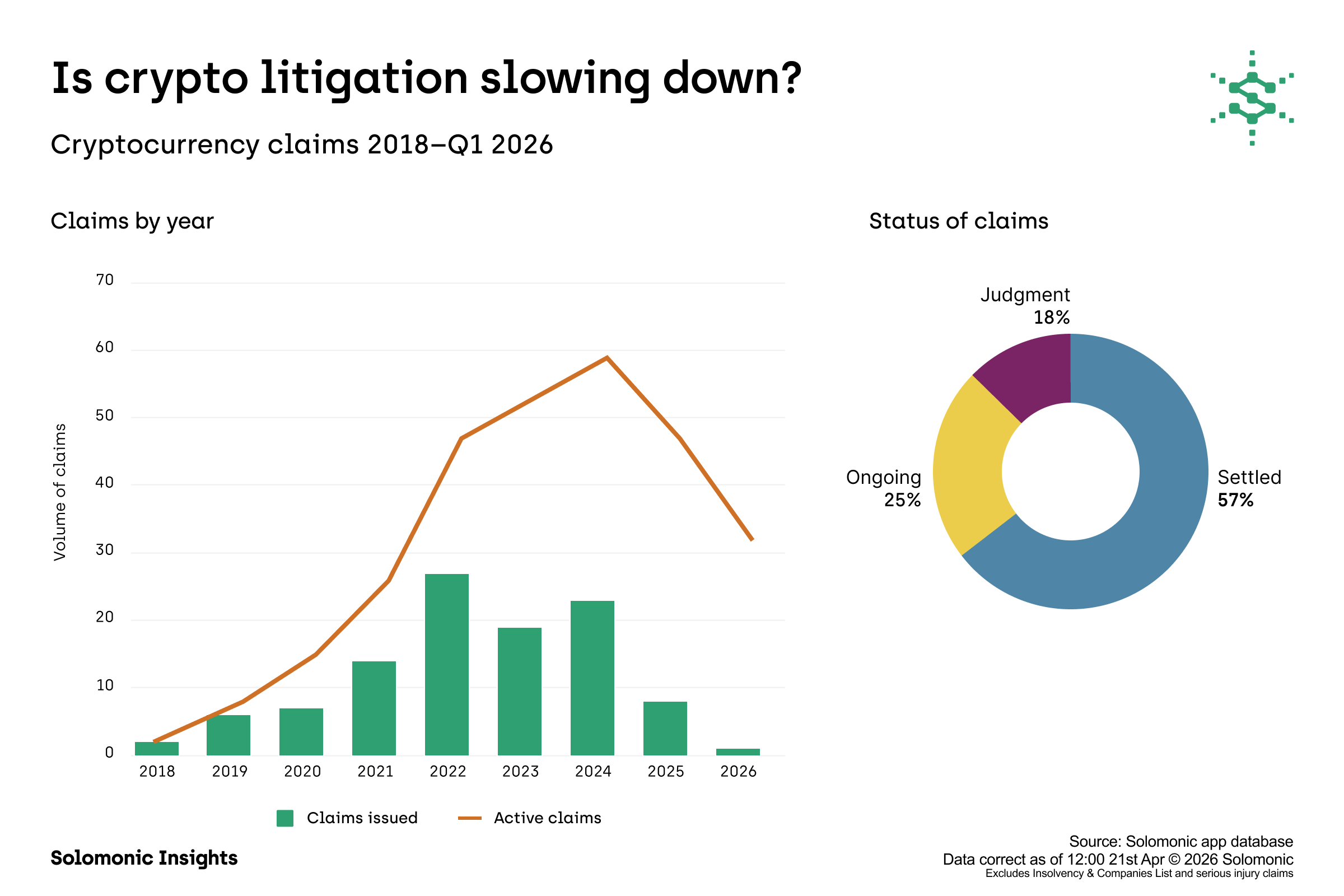
Cryptocurrency claims issued 2018–Q1 2026 and status of claims
Crypto-related disputes began to emerge in the High Court around 2018, with claim volumes rising steadily in the years that followed. Almost 70 were filed between 2022–2024. The number of active claims peaked in 2024 at 59, and amounts sought have reached into the billions of pounds, underlining the scale, complexity and significance of these disputes. By contrast, 2025 saw a slowdown, with only eight new claims filed.
Around a quarter of filed claims remain ongoing, indicating that the majority of crypto disputes are resolved relatively early. Most appear to settle, with just 18% of cases proceeding to judgment to date. Where cases have been determined by the court, outcomes have been more often favourable than not, with claimants succeeding in 63% of judgments.
This pattern suggests a strong commercial incentive to settle, likely driven by cost, uncertainty and market volatility. The relatively small pool of judgments also means that authoritative precedent in this area remains limited, leaving many key issues still to be tested in the courts.
As digital assets mature and become more integrated into mainstream finance, litigation trends are likely to evolve further. Key areas to watch include whether claim volumes will rise again, whether falling or rising crypto prices influence dispute levels, how insolvency and fraud claims develop and whether increased regulation drives more enforcement and shareholder actions.
We asked Financial Services Disputes and Investigations Partner, Martin Ward, at Eversheds Sutherland to share his thoughts on the direction of travel:
“Crypto-asset recovery claims remain most prevalent in the English courts through APP fraud, hacks and exchange scams, leading to a succession of reported decisions regarding (often uncontested) interim injunctions and the development of the ‘persons unknown’ jurisdiction. There also have been claims arising from investors in crypto platforms, particularly following high profile crypto exchange insolvencies.
In terms of disputes arising in the mid-term, claims and regulatory scrutiny against crypto exchanges and platforms are likely to increase as they start to become regulated by the FCA (expected in late 2027).
In terms of pressure points for crypto-asset recovery claims, jurisdiction and enforcement remain issues given the cross-border nature of crypto and the pseudo-anonymity of the blockchain. Tracing crypto assets can be complicated by the use of mixers, chain hopping or off-chain channels. The volatility of the crypto market introduces difficulties in trying to value those assets at specific points in time.
Litigation is likely the preferred route for fraud claims where urgent interim relief and actions involving persons unknown are required. The English court's developing expertise and favourable approach to such claims makes it a preferred forum for high-value recoveries. Similarly, investor claims against exchanges and platforms have been seen in the English courts, where those investors are not bound by an arbitration clause. Arbitration tends to be favoured for disputes between institutional parties (e.g. between platforms) due to its confidentiality, expertise in technical matters and easier cross-border enforcement of awards.”
Whatever direction the market takes, it is clear that crypto litigation is to remain an area of growing legal significance.
If you would like to learn more about Solomonic’s award-winning litigation data and analytics, trusted by more than 10,000 practitioners and 60% of the UK’s top 50 litigation firms, please get in touch with us at info@solomonic.co.uk for a confidential introduction to the platform.