
Probate litigation on the rise
Shifts in social demographics, combined with ongoing economic pressures, are driving probate claims - Solomonic data shows that 2025 is another record-breaking year for probate disputes.
New claims were up 7% on the previous year and more than 11% on 2020 — the year Covid struck — all of which suggest the litigation sector is in good health. Contributing to that growth was a rise in public sector disputes, up by more than 30%. The property sector was also busy, and, although down a couple of percentage points, the financial sector continued to dominate.
A meaningful rise in probate cases also drove the change as social demographics and economics create an ongoing growth in these disputes. Our analysis today takes a look at this area further.
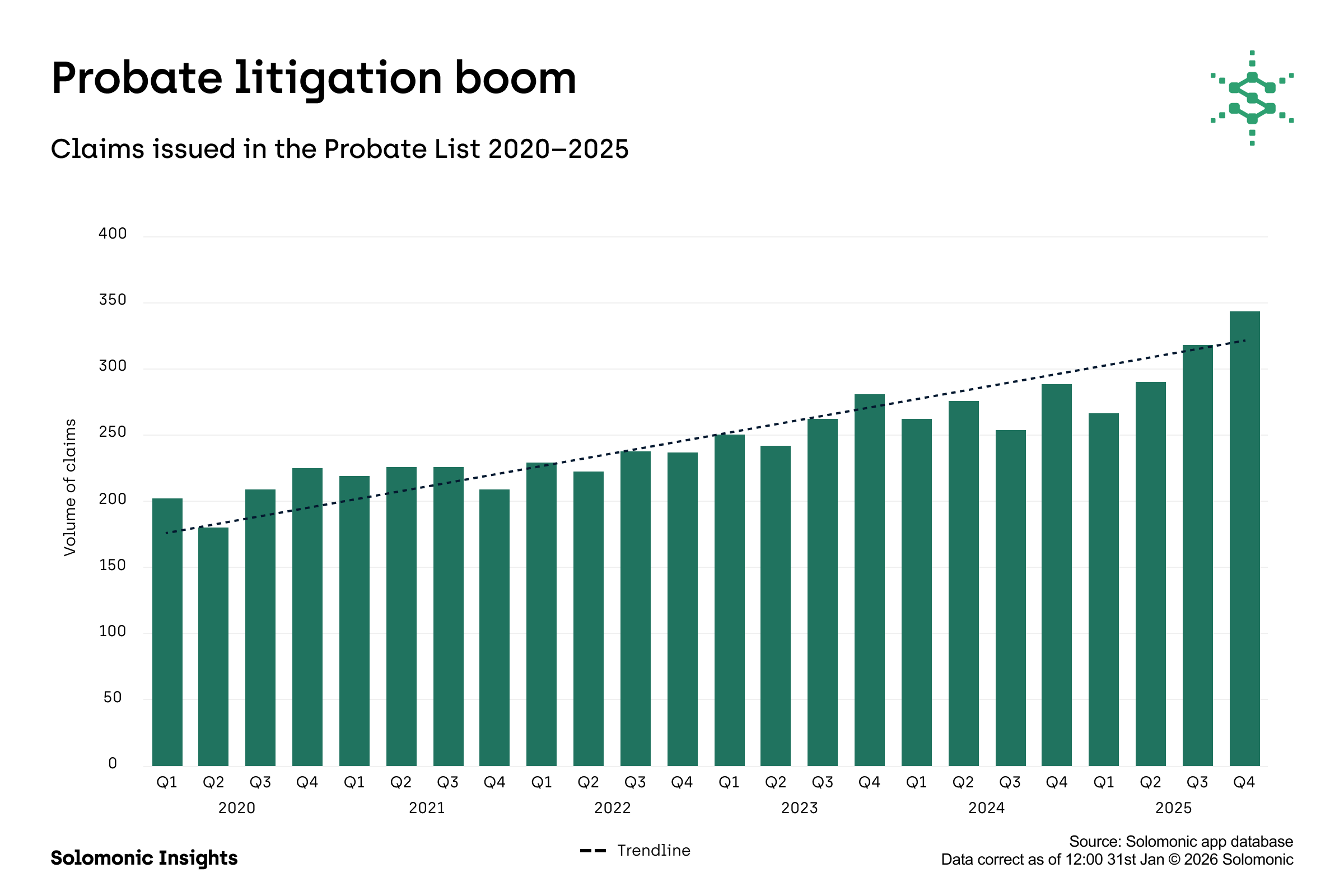
The data shows a clear upward trend in probate claims, with 2025 proving a particularly active year. New claims issued in 2025 were 13% higher than in 2024 and Q4 2025 recorded the highest quarterly volume of the decade so far.
Andrew Bishop, Partner at Rothley Law, offered his perspective:
“Probate claims have increased substantially over the last decade. Since I joined the industry in 2016, the number of enquiries, trials and work generally has notably increased (so too has been the number of NQ’s and Associates recognising the area and wanting to qualify into this work).”
The factors underpinning this expansion.
“Modern families - From my experience, this is the most common factor. Legislation governing Wills is from the Victorian era, but whilst some changes have been made to support blended families, there has been no serious attempt to update the law of Wills (unless the Law Commission proposals are taken forward). The increased divorce rates and second (or more) marriages create more disputes between children and new spouses. At the backbone of this area is the Inheritance Act which has been used more widely to challenge testamentary decisions when modern families are involved.
Ageing population and increased estate values – there are growing statistics related to Dementia and Alzheimer’s within an ageing population. This naturally gives rise to arguments over capacity to execute Wills and gift assets during life. That issue combined with generally higher property prices and the "Great Wealth Transfer", where baby boomers are expected to transition an unprecedented amount of wealth, has also sparked increased claims and this trend will only continue to rise.
Supplementing the above catalysts are the cost of living crisis and (particularly when adult children are involved) growing dependency on inheritance. Disappointed beneficiaries are increasingly reliant on an inheritance to fund their costs of living and gain access to the property ladder. This trend is only set to rise and fits neatly with rights allowed by Parliament under the Inheritance Act.
Finally, there appears to be public appetite for both litigation (likely driven by the media reporting of probate court cases) and for DIY or cheaply prepared professional Wills. This combination combined with a vulnerable testator, a complex estate and a contentious decision to exclude family, will likely to lead to claims especially when no proper estate planning has been attempted.
The above are powerful factors that cause family members to take legal action and the trend is not likely to be reversed.
To read the full Year in Review and explore the key litigation trends in more detail, access the complete report here.