
Data centre disputes in England and Wales: Early litigation trends
Analysis of recent High Court claims, document trends and the dispute risks arising from rapid data centre expansion.
Fuelled by artificial intelligence, cloud computing and an ever-growing demand for information, the global race to build data centre capacity is transforming infrastructure investment at pace. In the UK, these assets are now recognised as critical national infrastructure, reflecting both their economic importance and the risks if they go down.
But as with previous infrastructure booms, rapid growth is rarely frictionless. Data centre disputes often involve a particularly challenging combination of compressed delivery timelines, technical complexity and commercial sensitivity - factors that may increasingly push parties away from litigation and towards arbitration.
What does the data suggest?
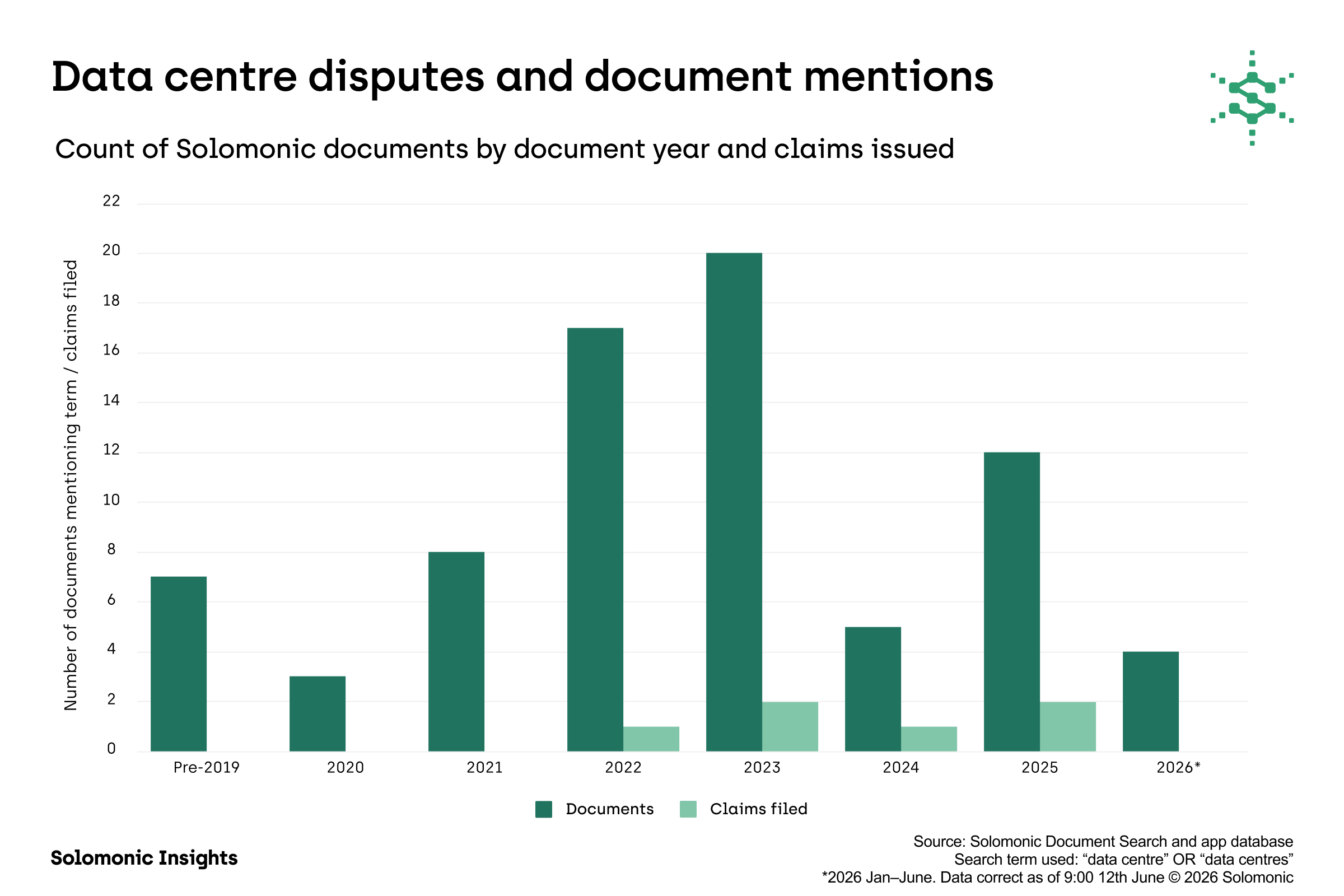
Data centre disputes and document mentions by year
Solomonic has identified six data centre-related claims issued since 2022. While this does not suggest an immediate boom, the cases filed to date are notable both for their value and the commercial attention they have received.
Of the most recent filed in the TCC, WSP USA Buildings Inc v AECOM Ltd & others (HT-2025-000283) involves a $17.2 million dispute between major engineering firms, alleging design defects at a hyperscale Frankfurt data centre leased by Google. WSP claims AECOM's detailed design flaws caused construction delays and forced WSP to settle with the data centre operator.
Issued late December 2025, with documents only recently becoming available, Medallion Data Centres brought a claim (HT-2025-000449) against Romanian contractor Infrapartners concerning a modular data centre in Lagos, Nigeria, which was due for completion in January 2025. Medallion is seeking damages and allege delays, defective and non-compliant works under a $35 million agreement. Notably, the agreement contains an exclusive jurisdiction clause in favour of the courts of England and Wales.
Using the Solomonic Document Search tool, we analysed how frequently “data centre/s” have been mentioned in High Court documents over recent years. Since 2020, the term has appeared in approximately 70 documents available through Solomonic. Mentions peaked in 2022 and 2023, broadly coinciding with the public release of generative AI tools such as ChatGPT. Mentions have slightly dipped in more recent years. While it is too early to draw conclusions (as documents often become available many months or even years throughout the dispute lifecycle), this may reflect the growing preference for ADR mechanisms, including arbitration, in large-scale data centre projects that need swift resolution.
We asked RPC’s Ankit Goyal, Partner and Head of India Desk, and Caroline Tuck, Partner, for their perspective on the developing landscape:
“Data centre disputes today are driven by the speed and complexity of delivery, with construction claims prominent: delay, acceleration, design change, commissioning failure and performance testing. Supply chain disruption and interface issues between multiple contractors and technology providers are increasingly common. Over time, disputes are likely to shift towards operational and technology matters as data centres integrate with AI and cloud ecosystems—raising issues around service levels, resilience, cybersecurity incidents and responsibility across complex contractual chains. Further, political and regulatory developments are likely to be an increasingly important driver of disputes. Data centres are no longer viewed solely as commercial assets; they are increasingly regarded as critical digital infrastructure underpinning economic growth and national competitiveness.
More broadly, geopolitical developments, trade restrictions and changing approaches to digital sovereignty may have downstream consequences for supply chains, procurement strategies and cross-border operations.
Risk is greatest at lifecycle “interfaces” where construction, power, technology and operations intersect. While compressed construction programmes remain high exposure, operational disputes may become more significant where uptime guarantees and customer expectations collide. Energy disputes are rising as power availability, pricing and infrastructure constraints become critical to viability.
Energy demand, sustainability and ESG are moving to the centre, with more disputes linked to renewable procurement, long-term PPAs and contractual carbon/efficiency commitments. Arbitration is often preferred for cross-border confidentiality and enforceability; litigation may suit urgent relief, broader disclosure, multi-party issues or precedent-setting.”
If you would like to learn more about Solomonic’s award-winning litigation data and analytics, trusted by more than 10,000 practitioners and 60% of the UK’s top 50 litigation firms, please get in touch with us at info@solomonic.co.uk for a confidential introduction to the platform.