
47% of breach of contract claims succeed in full. Negligence? Just 19%. Outcomes across ten High Court claim types and why a baseline matters.
Every litigator knows that no two claims are the same. But when it comes to claim strategy and forecasting, the starting point is often a general sense of how "this kind of claim" tends to go. Solomonic's outcome data puts numbers on that instinct.
We looked at outcomes across ten common claim types, set against a baseline (the historic outcome rate) of over 6,500 High Court (England & Wales) claims (excluding Insolvency & Companies List and serious injury claims). Here, "success" means a claim that succeeded outright or in part. Across the baseline, 58.2% succeed in some form and 42.8% succeed in full. Proceedings can involve more than one claim or cause of action, so the types overlap.
What does the data show?
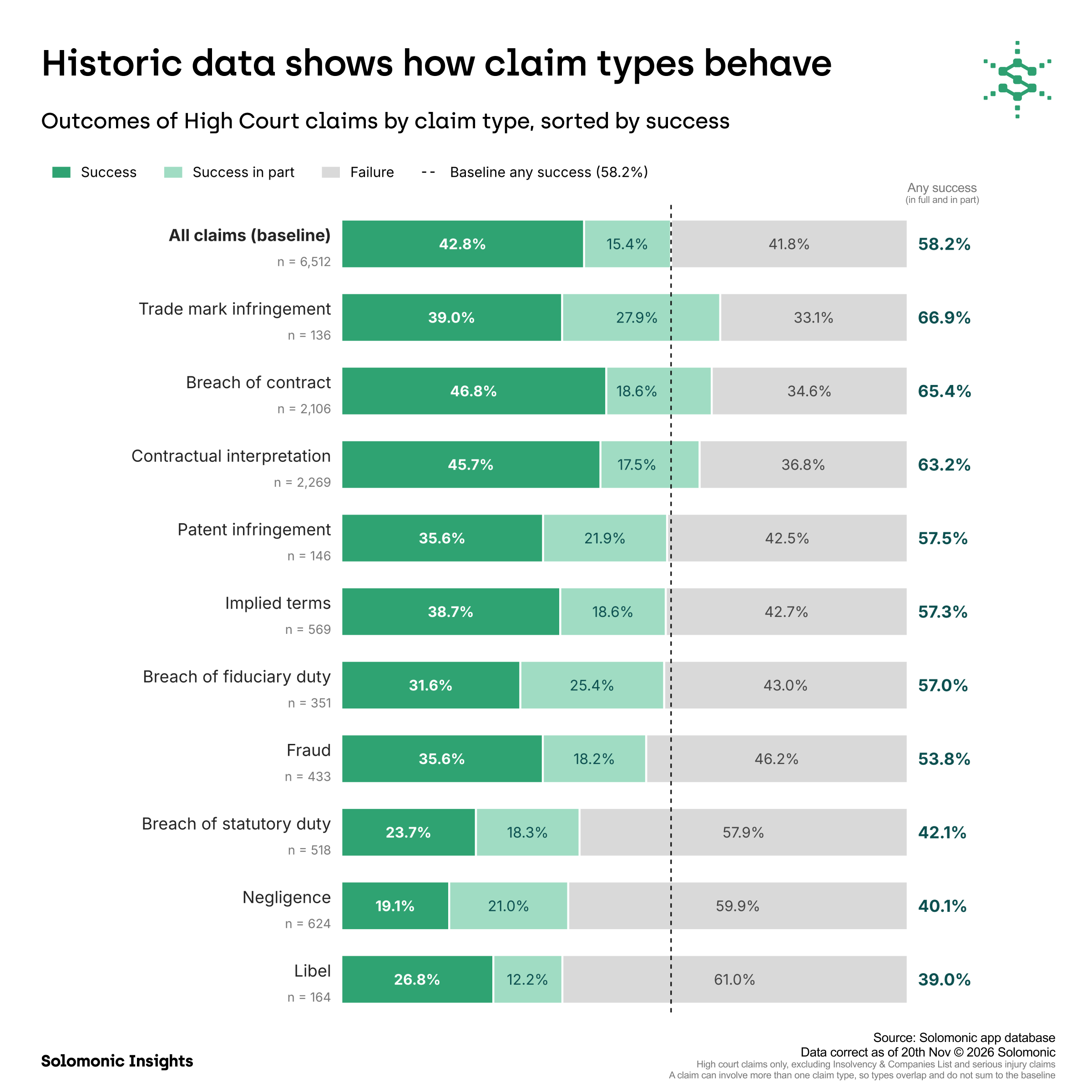
Outcomes of High Court claims by claim type, sorted by success
Contract-based claims do well. Breach of contract is one of the largest categories, with 2,106 claims with an outcome. Of these, 46.8% succeed outright and 18.6% in part, so 65.4% succeed in some form. Contractual interpretation, the largest category with 2,269 claims, follows at 63.2%. They are the only two types (analysed here) where outright success beats the historic outcome baseline (46.8% and 45.7% against 42.8%). Trade mark infringement has the highest rate of success in some form at 66.9%, but on just 136 claims.
At the other end, 61.0% of libel claims fail, based on 164 claims. Negligence claims fail 59.9% of the time, followed by breach of statutory duty claims at 57.9%. Of these ten claim types, negligence has the lowest outright success rate at just 19.1%. A breach of contract claim is almost 2.5 times more likely to succeed outright than a negligence claim (46.8% against 19.1%).
Claim type is only one of many factors that shape how a claim ends up. Our Claim Forecast Analysis brings together all of a claim’s metadata tags (such as cause of action, value, court, parties involved, law firm representation) to build a baseline specific to that claim. It gives you a data-led starting point to anchor on and the strengths and weaknesses of your own case to adjust from.
That is why baselines matter. The useful question is rarely "will this claim succeed?", but "what would we expect for a claim like this and how far does our case move us from that?" Starting from the right baseline is what turns a gut feel for a claim into a forecast you can defend.
If you would like to learn more about Solomonic’s award-winning litigation data and analytics, trusted by more than 12,500 practitioners and 60% of the UK’s top 50 litigation firms, please get in touch with us at info@solomonic.co.uk for a confidential introduction to the platform.