
As competition between jurisdictions intensifies, data shows that London remains a leading dispute resolution hub; balancing volume, speed and expertise.
At London International Disputes Week 2026, a panel bringing together the judiciary, the Bar, private practice and legal technology tested London’s reputation as a leading dispute resolution hub. Exploring data on litigation in London, the discussion focused on what the data actually tells us: where London leads, how this jurisdiction is evolving and what that means in practice for users of the system.
Chaired by Charlotte Hill (Partner at Penningtons Manches Cooper LLP) and in partnership with The Law Society, the session combined insights from the bench, including the Honourable Mrs Justice Dias DBE and the Honourable Mr Justice Waksman, with practitioner perspective from Maria Mulla (Barrister at Maitland Chambers) and data-driven analysis from Flavia Baldotto (Solomonic).
High Court’s immense scale and sustained demand
London’s courts are operating at sustained intensity with Solomonic’s analysis showing that in Q1 2026 alone, over 2,270 new High Court and Competition Appeal Tribunal public claims were issued, involving nearly 7,100 parties. This represents one of the busiest starts to a year since before 2020.
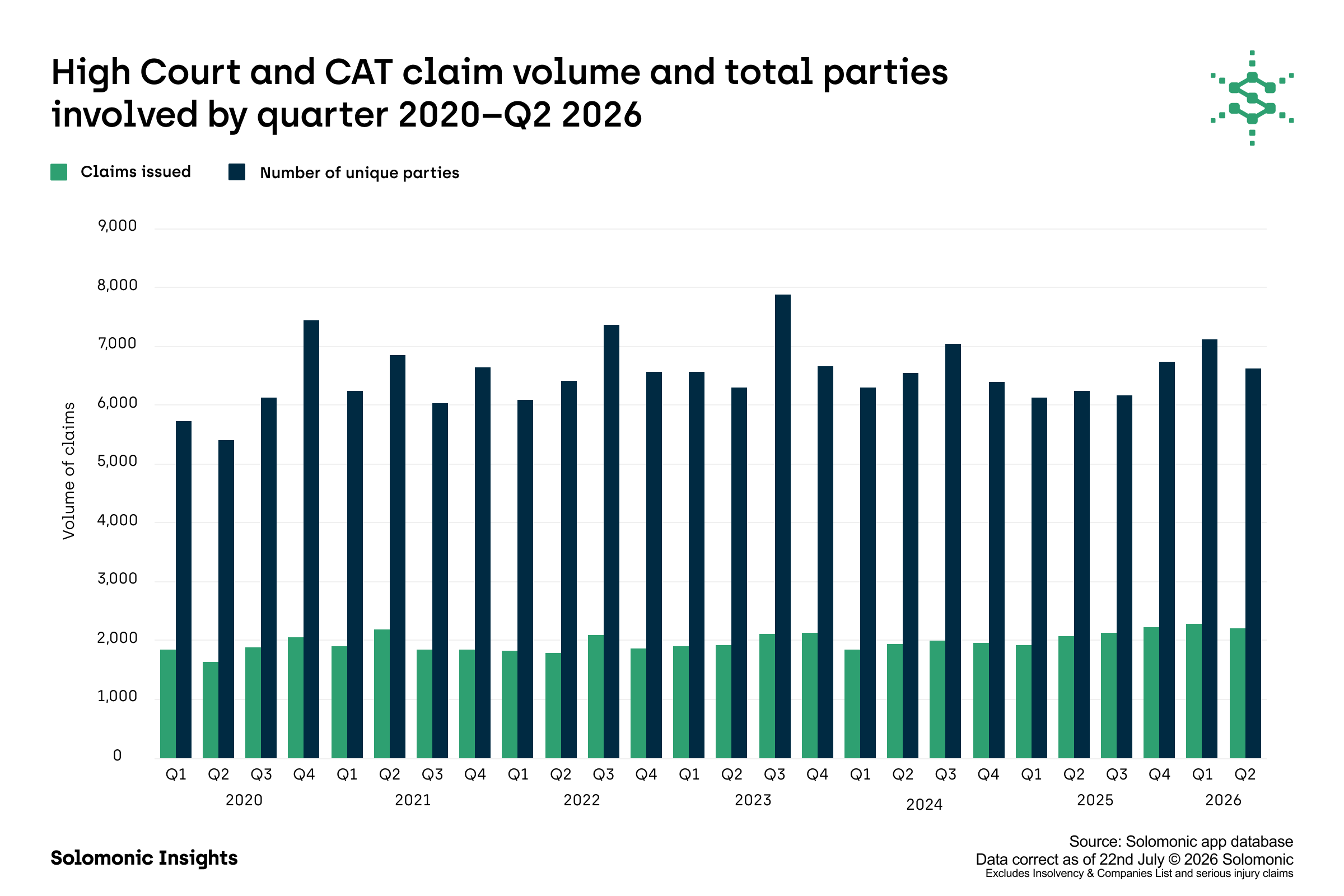
High Court and CAT claims issued 2020–Q2 2026
The data also indicates a growing array of active disputes, with close to 15,000 cases still progressing through the system at the end of 2025. This suggests a jurisdiction managing both high inflows and a persistent caseload, underscoring London’s preeminence in global dispute resolution.
"England and Wales remains one of the leading international centres for dispute resolution, thanks to our highly qualified and independent judges, procedural efficiency and the global enforceability of our legal framework. Looking ahead, sustained competitiveness will depend on ongoing, data-led evaluation and a proactive focus on strengthening our jurisdiction’s global offer to support future strategic engagement and client needs," commented Brett Dixon, Vice President of The Law Society.
Litigation and arbitration: complementary, not competing
A recurring theme throughout the discussion was the relationship between litigation and arbitration – often framed as a competing choice of dispute resolution, but increasingly viewed as complementary.
Although comprehensive arbitration data is limited, the Commercial Court Report 2024-2025 highlights the continued importance of arbitration to its workload, with arbitration-related matters accounting for around 30% of claims issued in 2024–2025.
Recent survey data reinforces arbitration’s continued prominence in cross-border disputes. The 2025 Queen Mary University of London / White & Case International Arbitration Survey found that 87% of respondents prefer arbitration (either as a standalone mechanism or alongside other ADR processes), underlining its enduring appeal as a flexible and enforceable dispute resolution tool.
Earlier editions of the survey have shown similar trends, with up to 90% of respondents identifying arbitration as their preferred method for resolving international disputes, often in combination with mediation or other processes.
This data highlights not only the popularity of arbitration, but also its increasingly integrated role within a broader dispute resolution framework, where parties are combining litigation, arbitration and ADR tools to achieve more tailored and commercially effective outcomes.
Panellists emphasised that London’s strength lies in this ecosystem effect and the ability to offer both litigation and arbitration expertise.
Commercial Court’s international reach
One of the strongest themes to emerge, both from the data and the panel discussion, was London’s wide international appeal.
The Commercial Court published that the “Court’s caseload remains predominantly international, with approximately 75% of cases involving parties or subject matter outside the United Kingdom in the 2024-2025 legal year”.
Looking at the top 1,000 most litigious organisations only in Solomonic’s dataset (which tracks over 150,000 organisations), around 92% are British-headquartered. The remainder reflects a broad international presence, led by European-headquartered entities (comprising approximately 5,500 claims), alongside a notable US presence (over 1,050 claims) and a long tail spanning the Middle East, Asia and Africa.
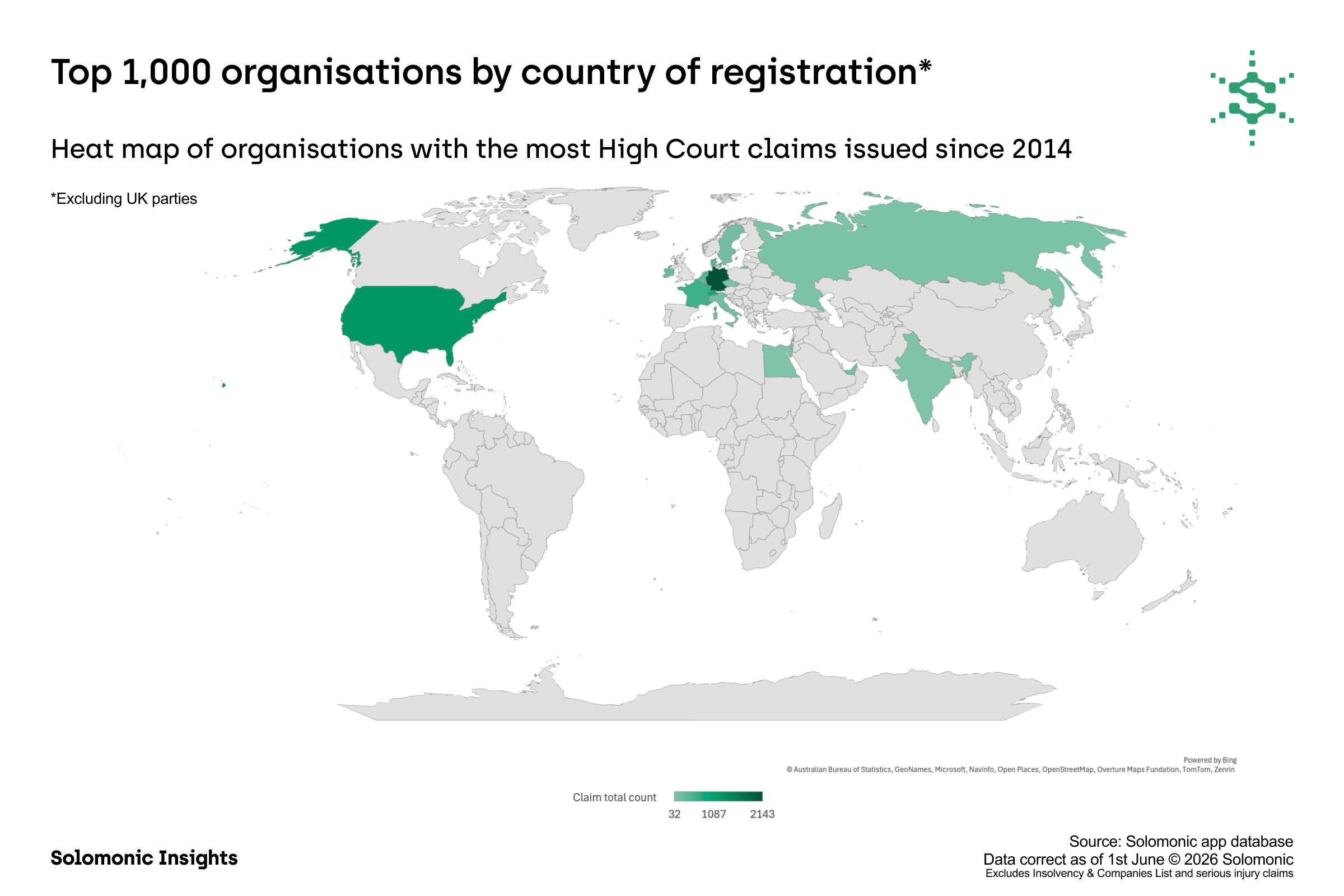
Country of registration heat map of the top non-UK 1,000 organisations by High Court claims since 2014
One reason litigation is brought in London is the widespread use of English law as the governing law in commercial contracts. While this remains a key factor for many in the choice of the English courts as a forum, Solomonic’s analysis shows a growing proportion of Commercial Court cases now involve the application of foreign law.
The data shows a notable increase in 2023 (to 14%) and 2024 (to 19.5%) driven in part by Russo-Ukrainian aviation disputes and matters involving Russian law. More broadly, around 7–8% of Commercial Court disputes involve reference to non-English law including EU law, US law, Italian law, Swiss Law, French law, Nigerian Law, German law and Emirati UAE law.
Whether applying English law, or analysing a dispute through the prism of foreign law, the volume of disputes with an international element reinforces London’s role as a globally significant disputes hub.
Preeminence in handling complex and specialist matters
While overall volumes are increasing, the data also reinforces London’s enduring strength in attracting and efficiently managing complex, high-value commercial disputes.
The composition of claims illustrates this clearly. Between 2023 and 2025, around 70% of cases involved contractual issues, alongside 27% involving negligence and 15% featuring fraud-related allegations, including deceit and conspiracy.
Beyond these core categories, the courts are handling an increasingly sophisticated mix of matters. These range from arbitration-related disputes and shareholder conflicts to insolvency and restructuring cases, insurance and reinsurance claims, and banking or financial markets litigation. More recently, this has been complemented by emerging areas such as developing technology and crypto disputes, reflecting the evolving nature of commercial risk.
Maria Mulla states: "The Commercial Court has consistently demonstrated its ability to adapt to an increasingly diverse and sophisticated disputes landscape. Whether dealing with complex cross-border fraud, digital assets, AI-related issues or novel commercial risks, the Court has shown both the flexibility and expertise needed to resolve disputes at the forefront of legal and commercial development. That adaptability is one of the reasons London continues to strengthen its position as a leading global disputes hub, attracting parties seeking judicial expertise in both established and emerging areas of commercial law.”
Court efficiency remains robust
Perhaps the most critical question for users of the system is whether London’s courts can maintain efficiency under growing demand.
The data offers cautious reassurance. Median claim duration currently sits at around 426 days (approximately 1 year and 2 months) across the key commercial forums (the Business List, Financial List, Commercial Court, and the Technology and Construction Court).
Notably, across the courts, median claim length to reach a judicial outcome has trended downwards over time, even as caseloads have increased – suggesting that the system has absorbed rising demand without a corresponding loss of efficiency.
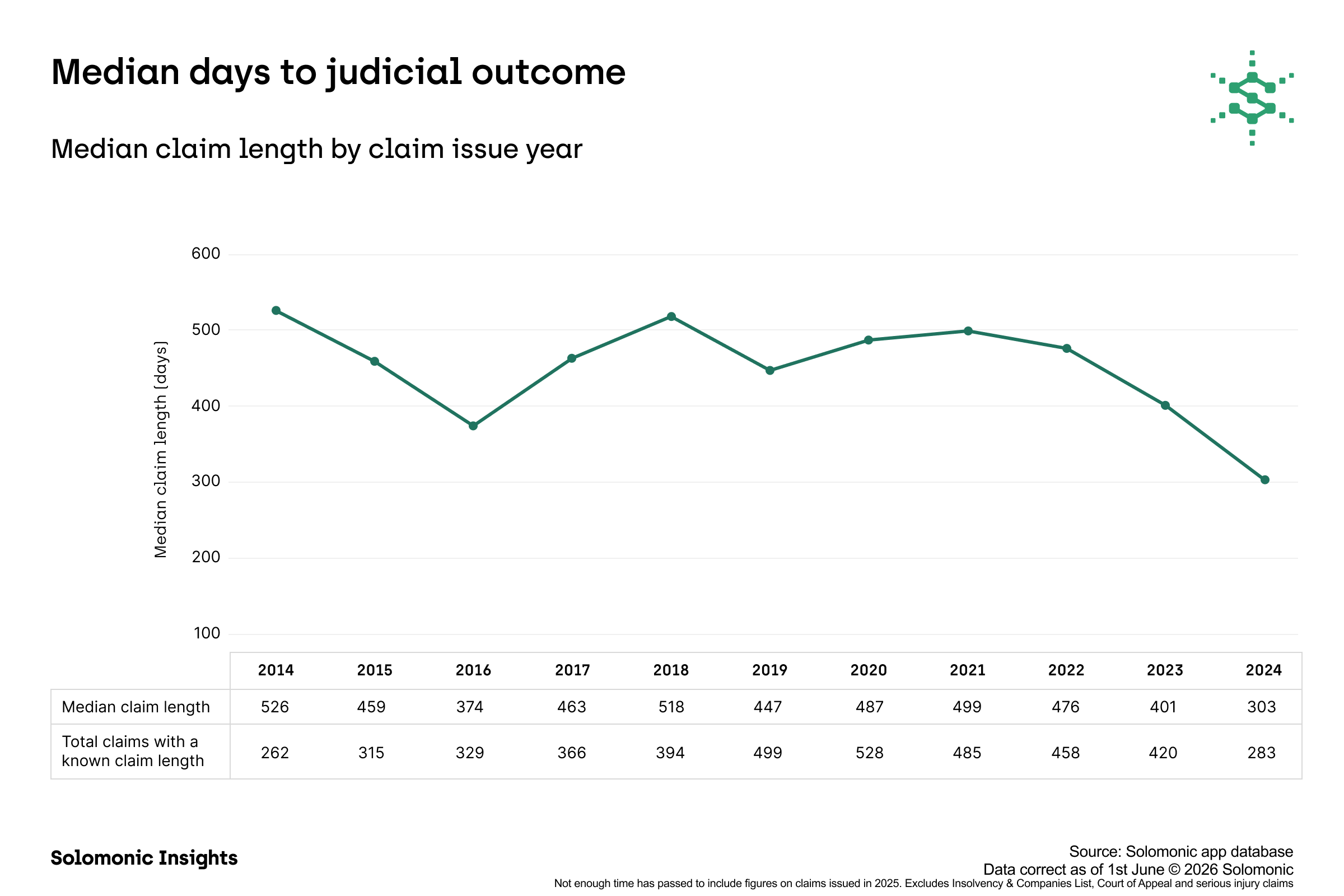
Median days to judicial outcome by claim issue year
Judgment hand-down times also remain relatively stable. While there has been a slight increase in the median time from hearing to judgment in recent years, this remains within a timely range. Moreover, it was cautioned by the panellists that this was likely due to the extraordinary length of time some trials were taking, owing to the extremely complex nature of the dispute (such as the Russo-Ukrainian aviation disputes, referenced above).
London’s reputation paired with data transparency
One of the most significant shifts explored in the session was how clients are making forum choices.
Historically, London’s position has been underpinned by reputation – judicial quality, predictability and the global reach of English law. But access to data and transparency are also now playing a central role.
Platforms like Solomonic are enabling lawyers to:
Analyse likely timelines and outcomes
Benchmark court lists, judges, counsel and experts
Identify patterns in similar disputes
This marks a shift towards more data-led litigation strategies, allowing both domestic and international clients to make more informed decisions when selecting forum, legal team and approach.
As Charlotte Hill explains, "Platforms like Solomonic are transforming how disputes are analysed and managed. By surfacing reliable, comparable data on courts, judges and outcomes, they enable lawyers to move beyond instinct and experience alone and towards truly evidence-based decision-making. This not only enhances litigation strategy but also supports clients in making more confident, commercially grounded choices about where and how to pursue their claims.”
Looking ahead: pressure, competition and opportunity
If the data confirms London’s current strength, it also raises important questions about its future trajectory.
Key themes emerging from the discussion included:
Global competition from arbitral centres and international courts
Cost pressures, particularly around disclosure and complexity
Technological change, including the role of AI in dispute resolution
The need for continued procedural innovation
The picture emerging from both the data and the panel is one of a jurisdiction that is not standing still. London’s courts are busier, more international and handling increasingly complex disputes – yet still delivering outcomes with a high degree of efficiency and predictability.
For clients and advisers, the shift is equally significant. The tools now exist to move beyond anecdote and intuition, towards a more transparent, evidence-based approach to litigation strategy and the ability to understand and quantify when and why London is the right forum.
The consensus was not that London’s position is unassailable, but that it remains highly competitive, provided it continues to adapt.
Solomonic’s data covers 12 years (2014–2026) of publicly available data on commercial disputes across the High Court, Competition Appeal Tribunal and Court of Appeal. The dataset does not currently cover the Admin Court, arbitration proceedings or private claims.
If you would like to learn more about Solomonic’s award-winning litigation data and analytics, trusted by more than 10,000 practitioners and 60% of the UK’s top 50 litigation firms, please get in touch with us at info@solomonic.co.uk for a confidential introduction to the platform.