
Collective litigation is growing across Europe, but in England and Wales the time taken to trial and judgment is stretching.
CMS’s recently published European Class Action Report 2026 found that collective litigation across Europe rose to 107 class actions filed in 2025, up from 99 in 2024, with the UK remaining one of the highest-risk jurisdictions for corporate class action exposure. The report landed alongside the publication of the third edition of Class Actions in England and Wales, co-authored by lawyers at HSF Kramer, a sign of how far the area has matured for practitioners.
Against that backdrop, Solomonic’s analysis points to a trend that matters for funders, defendants and claimants alike: group actions are increasingly taking longer to conclude at trial.
What does the data show?
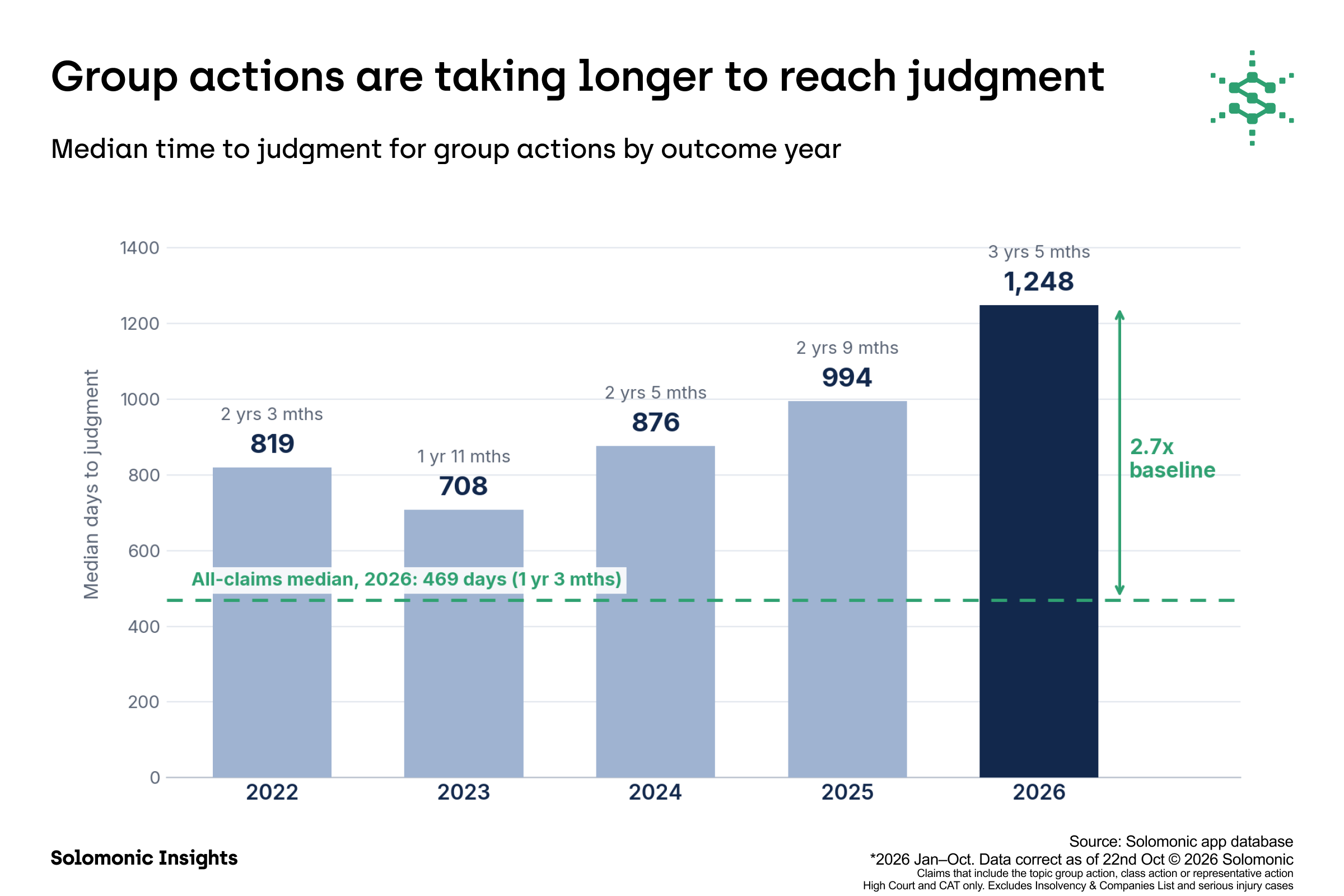
Median time to judgment for group actions by outcome year
The baseline for comparison is the median time to judgment across all claims, which stands at 469 days in 2026, or around 1 year and 3 months. That figure has been remarkably stable in recent years, sitting between 412 and 498 days every year since 2020.
Group actions have moved in the opposite direction. In 2022, the median time to judgment for a group action was 819 days, or about 2 years and 3 months, already well above the baseline. With the exception of a dip in 2023, that median has risen every year since and now stands at 1,248 days or around 3 years and 5 months. That makes group actions currently taking roughly 2.7 times as long to reach judgment as the typical claim.
The complexity of the cases now reaching judgment, multi-stage procedures such as certification hurdles, appeals, preliminary issues, trials split by issue or liability and general pressure on court resources are all likely contributors. Despite funding being harder to obtain, funding may also play a part. If the availability of litigation funding influences how many group actions are brought, it equally influences how long they run, since well-funded claims are better placed to sustain lengthy procedural contests. That link is a question the data raises rather than one it answers at this stage.
It is also worth treating the figures with some care. Group actions reaching judgment remain a small cohort, with 13 claims of known length in 2026 so far, compared with 23 in 2024 and just 6 in 2022. Claims that settle or are discontinued do not appear as judgments and 2026 is not yet over. Nevertheless, the direction of travel since 2023 is consistent.
Even as European class action volumes rise and the England and Wales regime attracts more practitioner attention, those considering or funding a group action in the High Court or Competition Appeal Tribunal should expect a materially longer road to judgment.
If you would like to learn more about Solomonic’s award-winning litigation data and analytics, trusted by more than 12,500 practitioners and 60% of the UK’s top 50 litigation firms, please get in touch with us at info@solomonic.co.uk for a confidential introduction to the platform.