
Football dominates High Court sports litigation, new data analysis shows
Football tops High Court sports litigation, ahead of motorsport and rugby, with disputes spanning personal injury, commercial claims and growing insolvency pressures.
With the FIFA World Cup 2026 underway, we analysed which sports are most frequently involved in disputes in the High Court (England and Wales).
The data shows a clear front-runner: football. But the wider picture reveals a diverse range of claims, from personal injury to high-value commercial cases.
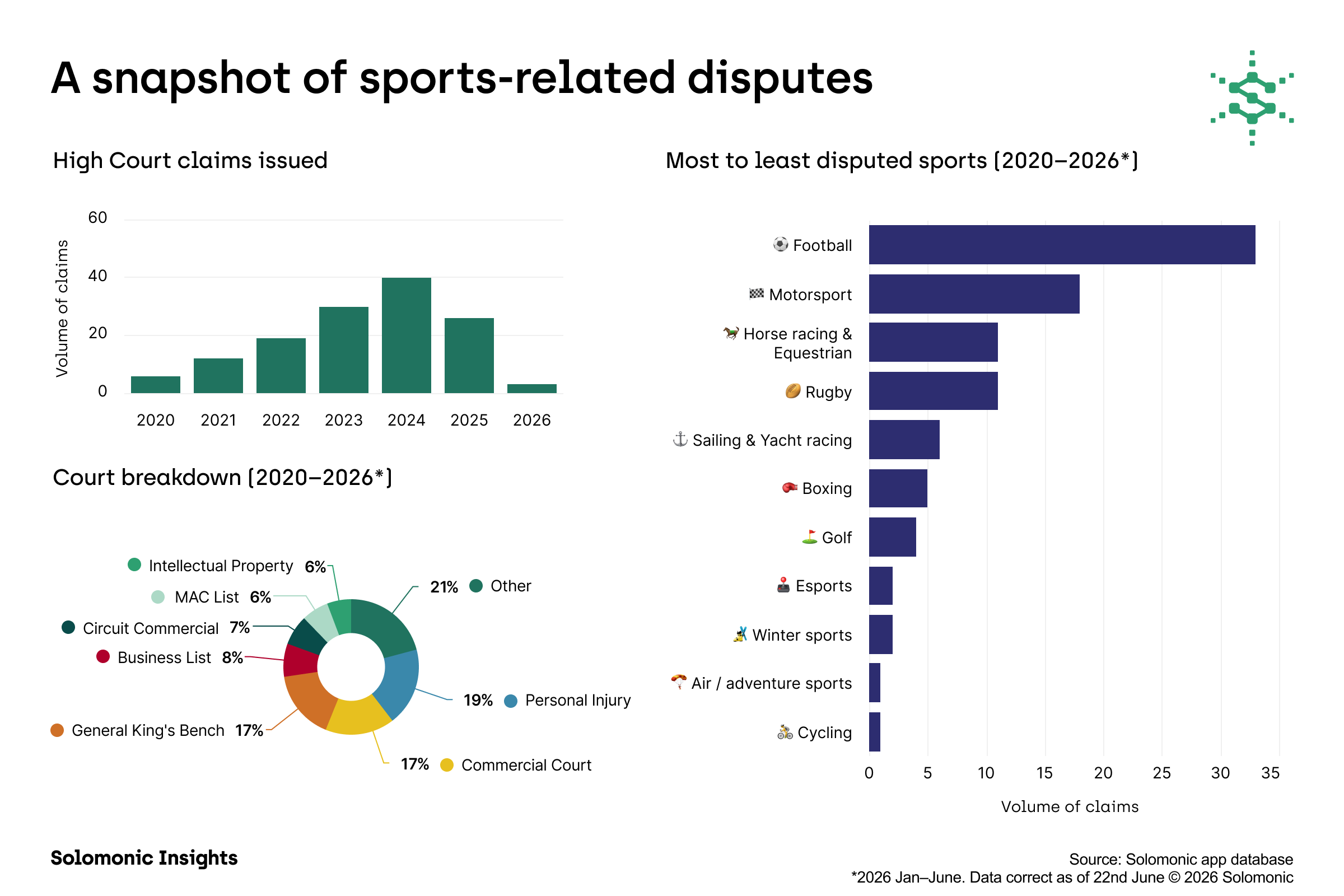
Since 2020, Solomonic has recorded over 135 sport-related disputes, with volumes rising steadily year-on-year for five years. Claims increased from 6 in 2020 to a peak of 40 in 2024, before dipping in 2025 (though a lag in document availability and analysis may pull this up).
A snapshot of sports-related disputes in the High Court (E&W)
Sports-related disputes appear across a wide range of courts. Personal Injury (26 claims) leads, unsurprising given the inherent risks of sporting activity and liability around injuries. The Commercial Court and General King’s Bench (23 each) reflect high-value contractual and business disputes. The Media and Communications List (9) highlights reputational issues, including defamation and the Intellectual Property List (8) captures disputes relating to advertising, design rights and merchandising.
Across all sports, football has attracted the highest volume of disputes, with football clubs sitting at the centre of the majority of cases.
Among the more prominent cases is Iconic Sports Eagle Investment LLC v Textor, a cross-border dispute involving equity interests in several football clubs. The case has drawn extensive coverage across both the sports and legal press, owing to its high-profile defendant (multi-club owner and former Crystal Palace director John Textor) and its significant value - over $93 million. Another widely reported football dispute was Tottenham Hotspur Football & Athletic Co Ltd v INEOS Automotive Ltd, a commercial conflict rooted in sponsorship and ownership tensions, which attracted mainstream media attention before settling by Tomlin order in November last year.
Motorsport, including Formula One, ranks as the second most litigious sport. The standout case is Massa v Formula One Management Ltd and others. The claim revisits the controversial 2008 Formula One World Championship and the “Crashgate” scandal, with Massa seeking to challenge the legitimacy of the title outcome. The defendants were recently granted permission to appeal to the Supreme Court following an order to pay Massa £250,000.
Another significant motorsport dispute is Rosgonki ANO v Formula One World Championship Ltd, concerning the cancellation of the Russian Grand Prix and a breach of contract claim arising out of sanctions imposed.
Horse racing and equestrian disputes, along with rugby, are tied as the third most litigious sports, followed by smaller volumes in sailing and yacht racing, boxing and golf. At the other end of the spectrum, skiing, paragliding and cycling (excluding everyday road traffic personal injury claims) rarely feature in High Court litigation.
Looking specifically at football, our analysis shifts from the dispute topics to the parties involved in litigation, providing a broader view of football’s legal footprint (as case topics are only identified through document analysis). This reveals a higher number of claims involving football clubs.
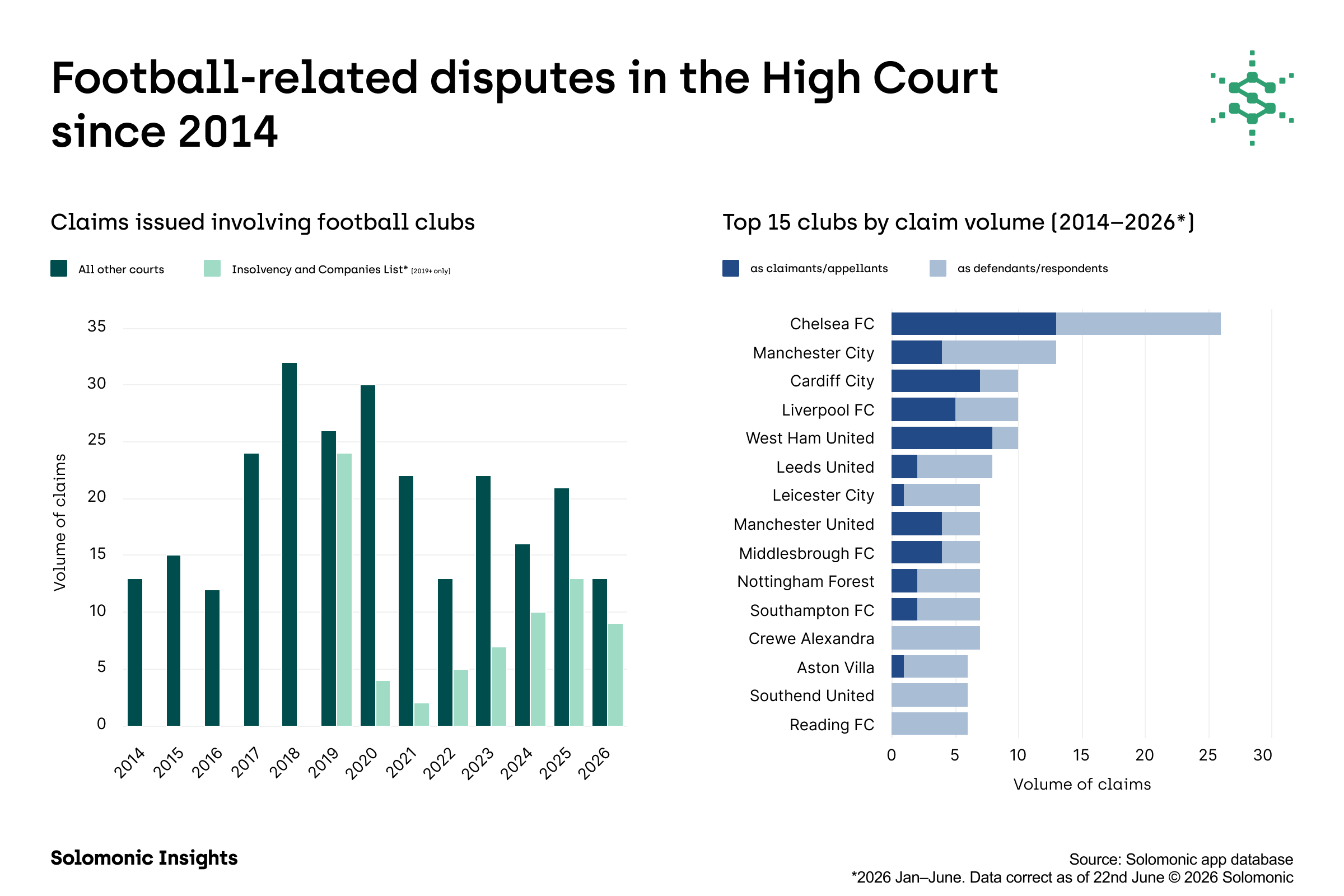
Since 2014, almost 350 claims have been filed in the High Court involving football clubs. The period between 2018 and 2020 was particularly active. Half of the claims in 2018 were brought by Bolt Burdon Kemp LLP on behalf of unnamed individuals, largely targeting Chelsea F.C., Leicester City F.C. and Manchester City F.C. In 2019, Chelsea F.C. alone issued nine claims against named individuals. Based on the documents, these largely relate to ticket touting.
Since then, annual volumes have stabilised, with an average of around 19 claims per year between 2021 and 2025.
Solomonic’s analysis of the Insolvency and Companies List is comprehensive from 2019 onwards, identifying more than 70 actions involving football clubs. 2019 marked a particular peak, with HMRC responsible for 75% of those actions, primarily issuing winding-up petitions (most likely to pursue unpaid debts rather than necessarily forcing liquidation). Activity dipped during Covid in 2020 and 2021 before rising steadily again from 2022, reflecting growing financial pressures across the game. Reading F.C., Southend United F.C. and Morecambe F.C. have been subject to the most winding-up petitions over the years.
The data shows that 2025 was another active year, with 21 claims issued across the courts and a further 13 in the Insolvency and Companies List. That trend has continued into the first half of 2026, with 13 claims and 9 insolvency matters already filed, suggesting another busy year ahead.
Football-related disputes in the High Court (E&W) since 2014
When it comes to individual clubs, Chelsea F.C. has been the most frequently involved in litigation since 2014, with 26 claims (50:50 claimant/defendant split). Manchester City F.C. ranks second, with a higher proportion of defendant-side involvement. Behind them, Cardiff City F.C., Liverpool F.C. and West Ham United F.C. round out the top five.
Further down the list, clubs such as Leeds United F.C., Leicester City F.C. and Nottingham Forest F.C. feature prominently, while lower-league sides including Crewe Alexandra F.C., Southend United F.C. and Reading F.C. appear predominantly as defendants.
Beyond clubs themselves, some football governing bodies are among the most active litigants. While not included in the above figures, The Football Association Premier League Ltd has been involved in more than 300 claims since 2014, ranking among the 50 most litigious parties in the High Court. In 97% of these cases it appeared as claimant, with the vast majority relating to intellectual property enforcement — particularly actions against individuals and businesses for copyright infringement and the unauthorised broadcasting of live matches. This activity peaked in 2015, when 109 claims were filed, although the volume has reduced considerably in more recent years.
While football dominates the litigation landscape, the wider picture points to a sport sector where commercial complexity and financial pressure are driving a steady rise in disputes.
If you would like to learn more about Solomonic’s award-winning litigation data and analytics, trusted by more than 10,000 practitioners and 60% of the UK’s top 50 litigation firms, please get in touch with us at info@solomonic.co.uk for a confidential introduction to the platform.